In a compound on the edge of Juba, the heat settles in before 9 in the morning and already a circle of women has gathered under the shade of a mango tree, a tin basin of mixed beads sitting between them. Akuol sorts colors by feel as much as by sight, her fingers moving over red, white and the deep blue she’s always called ‘sky’, separating them into smaller dishes without looking down. Around her, conversation moves between Juba Arabic and Dinka, rising and falling with the rhythm of the threading, broken occasionally by a child running through the circle chasing a stray bead that rolls into the dirt. Akuol has been doing this since she was nine years old, taught by her mother on a mat much like this one, in a village two days walk from where she sits now.
Nobody here is performing tradition for an audience. They are doing what their mothers did, in the place their mothers did it, because the doing itself is the point: paying school fees, killing time between one chore and the next, keeping a language of color and pattern alive in their hands so it doesn’t have to live only in memory.
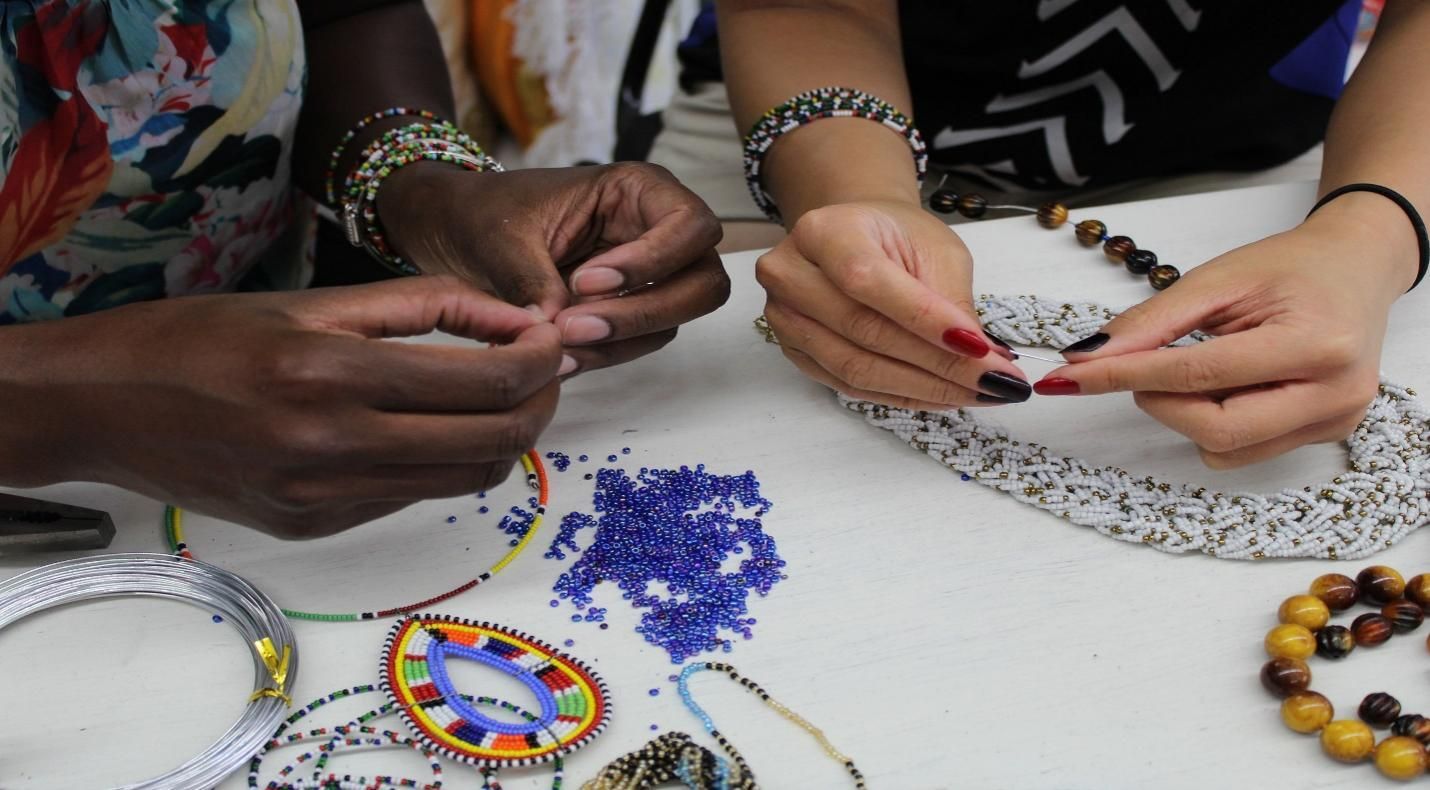
A group of women bead together in the shade, a practice that doubles as both income and daily ritual. Source: Space2b Social Design — African Beading programme
Threads that Predate the Border
Long before South Sudan existed as a line on a map, beads already carried meaning across the communities that would come to live within it. Among the Dinka, the beaded corset known as Alual (for women) or Malual (for men) was never simply decoration. Colors and density announced age-set, marital eligibility, family standing; the way a corset was built could even signal the size of bride price a family expected in cattle.
Girls wore increasingly elaborate corsets through adolescence, and a tightly built one might be cut away only on a woman’s wedding day, the cutting itself a small ceremony marking the end of one life stage and the beginning of another. Much of what’s documented about these garments today survives through museum collections and ethnographic archives, rather than through South Sudanese institutions - which is itself a quiet reflection of how unevenly this history has been recorded and preserved (a gap researchers such as those cataloguing pieces for the Tribal Gallery archive have tried to fill from outside the country itself).
Other communities carry similar but distinct traditions. Among the Nuer, beadwork historically incorporated ostrich eggshell long before glass trade beads arrived along regional trade routes, laboriously chipped, drilled and strung into necklaces and waistbands. The Bari and the Shilluk have their own color grammars, their own occasion specific pieces worn at initiation, harvest, or mourning. None of these traditions is interchangeable with another even though outsiders often flatten them all into a single idea of “African beadwork.” What unites them is not a shared pattern but a shared logic: beads as a language fluent women read on each other’s bodies without needing it explained.
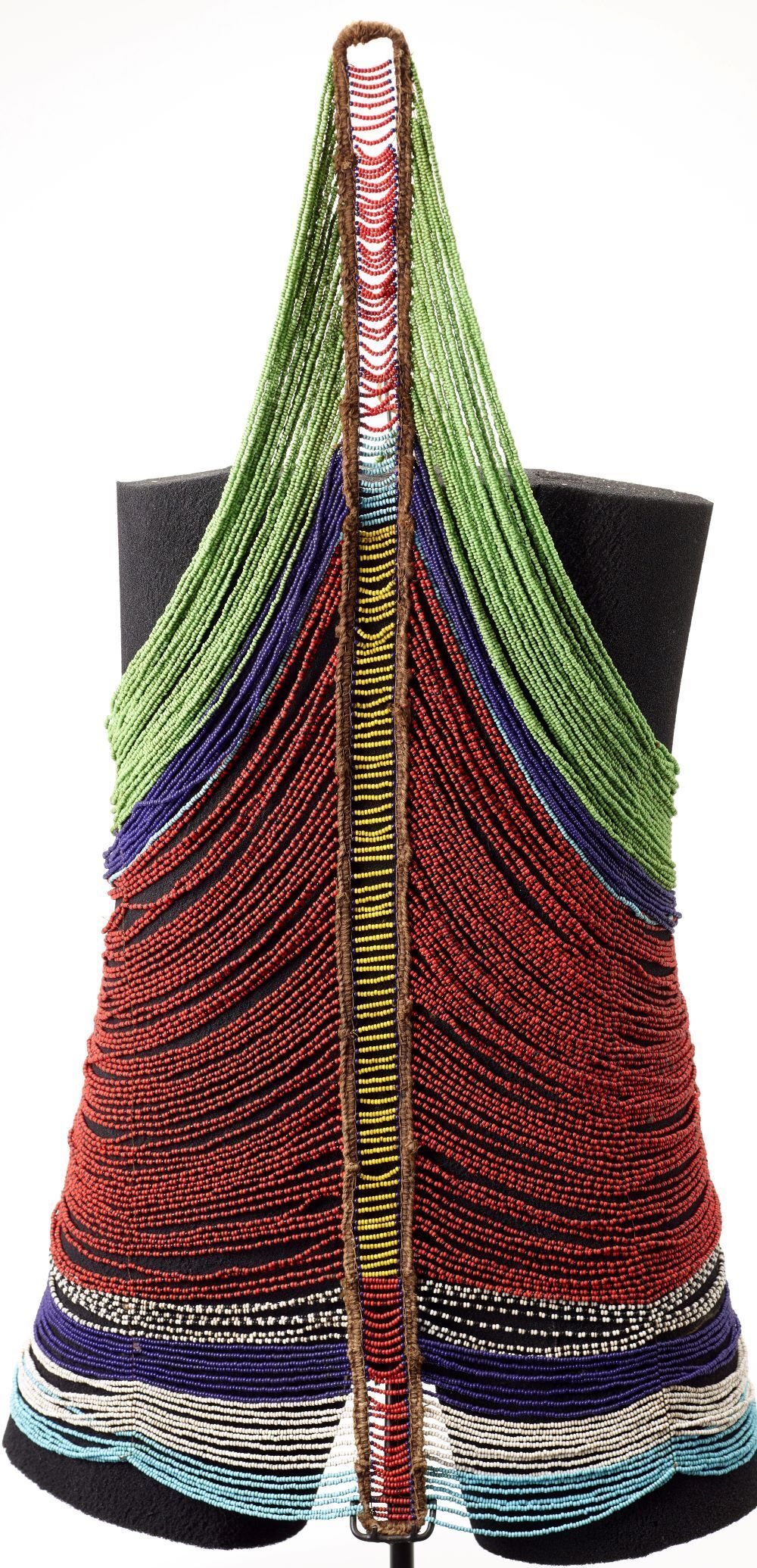
A traditional Dinka woman's beaded corset, its color bands once signaling age-set and family status. Source: ROOTS of South Sudan — beadwork archive
What the Women Say
Ask Akuol why she keeps beading, hour after hour under the mango tree, and the answer rarely sounds like the language of ‘cultural preservation’ that outsiders reach for. She beads because the work pays for things cash from nowhere else can cover; her younger sister’s exercise books or a bag of sorghum when the market price spikes. “The beads don’t forget to pay me,” she says, half joking, while still sorting colors. For her, beading is closer to a small, steady insurance policy than to heritage on display.
Beside her, a younger woman named Nyanluak listens more than she talks. She is preparing to join an uncle in Kampala within the month, and she has been beading every day this week, she says, partly to sell what she can before she leaves and partly because she wants the pattern memorized completely in her hands, not just her eyes before she has to start over somewhere else. “I want my hands to remember even if I forget,” she says. Her sentence sits in the circle for a moment before the threading starts again, a small admission of how much is riding on a skill that, unlike papers or property, cannot be confiscated at a checkpoint.
One Craft, Many Hands, Many Places
Inside South Sudan, beadwork still answers to the rhythms of weddings, cultural festivals, and the everyday markets of towns like Juba, where strings of beads are sold alongside vegetables and secondhand clothing, priced by negotiation rather than by tag. From there, the trade fans outward in step with the people who carry it.
In Nairobi and Kampala, South Sudanese women sell beaded jewellery to each other and to NGO workers, sometimes folding it into wider East African craft markets where the line between South Sudanese, Kenyan, and Ugandan beadwork blurs at the edges. Further still in Calgary (Canada) the same craft becomes something closer to cultural infrastructure: a reason for women to gather weekly, a way to mark South Sudanese identity for children raised mostly on another continent’s calendar.
The materials shift along the way, too. In rural South Sudan, beads made from ostrich eggshell or local seeds remain in circulation precisely because they are accessible without cash. In diaspora communities, imported glass and plastic beads dominate, bought in bulk from craft suppliers rather than gathered or bartered. The symbolism often survives the substitution; the color codes for courage, purity, and peace persist even when the physical bead has changed continents and material entirely.

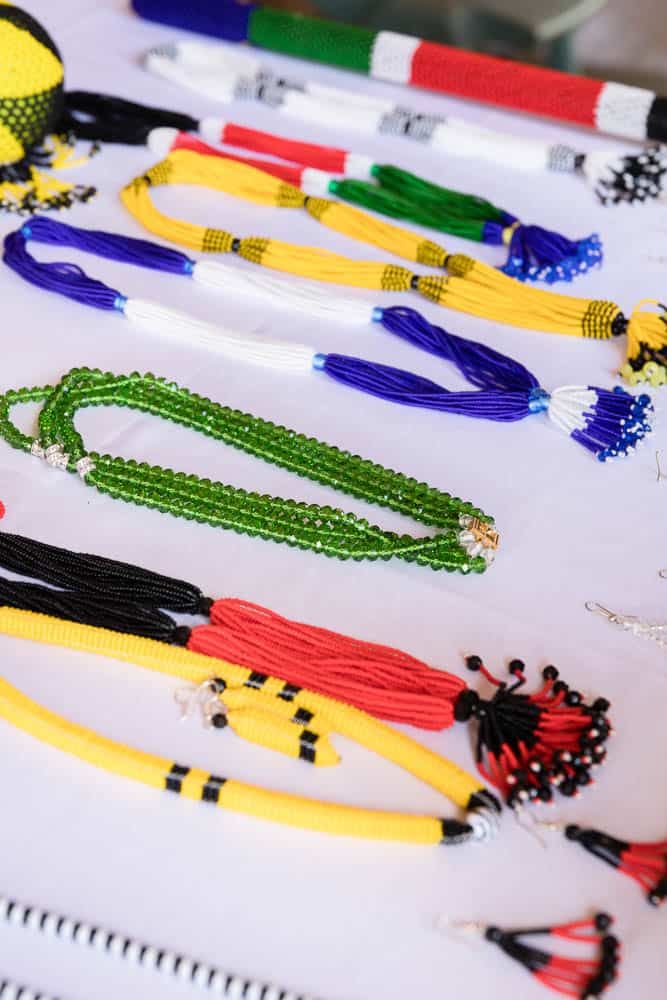
Strung beads for sale alongside other goods in a South Sudanese market, where pricing is negotiated rather than fixed. Source: Alamy — Market, Juba, South Sudan
Where the Thread Lands
Follow that outward movement far enough and it eventually reaches a converted machinery shed at the Fairfield City Museum and Gallery, in the suburb of Smithfield within the City of Fairfield local government area of Western Sydney, New South Wales, Australia, where, on Saturday mornings, a different circle of South Sudanese women sit around a long trestle table that once held tools instead of beads.
The shed still smells faintly of engine oil beneath the spiced tea someone has brought; the conversation moves in quick, overlapping Dinka, the same language Akuol and Nyanluak speak under their mango tree, now carried twelve thousand kilometers and reassembled in a room built for something else entirely. A woman who arrived in Australia after years in a refugee settlement describes the workshops as a form of sanctuary a word that captures something the data never could: that for displaced women, picking up beads again is not nostalgia, it is one of the few acts of continuity fully within their control.
South Sudanese women bead together at a community workshop in Western Sydney, continuing a practice carried from home. Source: Garland Magazine — “Creating Sanctuary through Beading”
What War Unravels, and What it Cannot
Civil conflict and repeated waves of displacement have done real damage to the conditions under which beadwork is taught and sold. Markets close when towns empty. Supply chains for imported beads break down when roads become unsafe. Skills that are normally passed hand to hand across a kitchen table or a workshop floor are harder to transmit between a mother in a camp and a daughter she may be separated from for months.
Researchers and journalists who have tried to document the scale of South Sudan's beadwork economy run into the same wall repeatedly: this is a largely informal, often barter-based economy, and no government body or international agency currently tracks how many women practice the craft, what share of household income it represents, or how much beadwork crosses the border for sale abroad.
And yet the craft has proven unusually resistant to the conditions meant to destroy it, because it requires so little to restart. A woman who has lost almost everything can still find or improvise beads, still remember a pattern, still teach it to a child within days of arriving somewhere new. That portability is precisely why beadwork resurfaces so reliably in refugee settlements and diaspora communities; not because the craft is sentimental, but because it is genuinely one of the few things war cannot fully confiscate. The skill lives in the hands, not in a workshop that can be burned or a market that can be shut down.
Counting What Resists Counting
Hard local data on South Sudan’s beadwork trade is all but nonexistent, a situation that researchers attribute to the informality of the country’s economy and the limited reach of formal data collection. What does exist is some compelling broader context suggesting the magnitude of opportunity hiding beneath this gap: global market researchers such as Grand View Research and Zion Market Research put the worldwide bead-jewellery and accessories market in the low billions of US dollars as of the mid-2020s, with continued growth projected through the end of the decade, driven primarily by burgeoning demand for handmade and culturally distinct accessories versus mass-produced jewellery.
African bead products already account for a meaningful share of that global trade, suggesting that artisans across the continent, including South Sudanese women working informally, are playing in a growing game even if they lack the stats to prove it precisely. What has changed recently has as much to do with materials and technique as with markets. Many bead makers now deliberately mix old and new, keeping the color symbolism and pattern logic of traditional design while working in imported glass or plastic beads that are cheaper, more consistent, and faster to source than eggshell or seed. This isn’t diluting the craft so much as adapting it in order to keep it economically viable, a strategy selected by the women themselves rather than having been forced upon them, to continue making beadwork pay for school fees and rent in a way that pure tradition alone increasingly cannot.
Put in concrete terms, a simple strung seed-bead necklace of the kind Akuol and Nyanluak make under the mango tree can take a few hours of steady threading, while an intricately patterned choker with tighter stitching and colour-matching can occupy a woman on and off for several days. At the far end of the craft, a full Dinka beaded corset, the kind once cut away only on a woman’s wedding day, is a project measured in weeks rather than hours; even the simplified, contemporary corsets now produced by revival projects, such as South Sudan’s Roots Project, are described by their makers as taking a few weeks of dedicated work to complete.
On the selling side, finished South Sudanese beaded pieces in diaspora markets tend to run from around USD 25 for a single-strand necklace or a pair of earrings up to USD 70 or more for a triple-strand piece according to Taste of South Sudan. Prices have to cover both the beads themselves, which are typically imported and bought in bulk, and the many hours of hand-threading that go into a finished piece, which is why the income involved is better understood as fair payment for skilled, time-intensive labor.
Full Circle
By early afternoon in Fairfield, the trestle table is a small chaos of finished and unfinished pieces: a Dinka pattern choker next to a more contemporary bracelet mixing imported beads with a single ostrich-shell pendant, someone’s relative sent from a market in Juba. A woman holds her finished necklace up to the light from the shed’s high windows, checking the color sequence one last time before tying it off.
The conversation in Dinka rolls on without pause, the same overlapping rhythm that, on the other side of the world, still rises and falls under Akuol’s mango tree where Nyanluak has probably already left for Kampala, her hands carrying the pattern she was so desperate not to forget. Nothing about either scene wants to be called “resilient” or “empowered”; those are grant-report words, not an ordinary afternoon spent threading beads.
What is really going on is smaller and longer lasting than either word: a skill passing from one set of hands to another then to another again the way it has done for generations, no matter which country those hands happen to be in. That is what continuity looks like in practice: not a single unbroken thread but thousands of small, intentional knots, retied every time the thread gets cut, from a mango tree on the edge of Juba, to a converted machinery shed twelve thousand kilometers away.