Did you take out the trash today? And where did you put it in a bin or a designated waste container? It seems straightforward and normal, doesn’t it?
In the capital, Khartoum, however, things are entirely different. All you have to do is dump your rubbish bag at the nearest spot to your home. It could be next to a school, in an open field, or even outside an abandoned house whose owners have yet to return from displacement.
The important thing is to get rid of the rubbish, regardless of where it ends up. As this scene repeats itself day after day, a more pressing question arises: how did we reach a point where disposing of waste this way has become normal?
As this situation continues, the problem can no longer be attributed solely to individual behavior. It has become part of a much larger issue: the ability of the waste management system itself to cope with the growing volume of rubbish. The war, combined with inadequate funding, has contributed to the deterioration of the system and reduced its capacity to provide services.
“Waste management operations rely on their own resources, with no form of government support. Any assistance provided to the department comes from local and international initiatives and organizations.” — Al-Siddiq Abdul Qadir, Operations Manager for the Waste Management Authority in the Bahri locality.
This report examines the waste crisis in Khartoum and Bahri, highlighting the decline of the waste management system, the challenges residents face in dealing with mounting rubbish, and the resulting health and environmental consequences.
The collapse of the waste management system amid a lack of funding
In an interview with the head of the Waste Management Authority in Bahri Locality, Andariya discussed the problem of rubbish accumulation in the city and the reasons behind the decline in waste collection services across residential neighborhoods, despite residents returning and daily life resuming a more normal rhythm.
What are the main challenges facing waste management in Bahri Locality?
Al-Siddiq Abdelgadir describes a range of interconnected problems facing waste management, the most significant being a shortage of equipment caused by the war. Large numbers of vehicles and machinery were stolen, while other equipment remains out of service and requires costly repairs.
The cost of fuel needed to operate the available vehicles adds to these challenges. The department must cover these expenses despite low revenues and the absence of sufficient government funding.
The problems extend beyond equipment and fuel. The department also faces challenges related to salaries and staffing. Abdelgadir explained that the department is currently operating with a limited number of workers, whose efforts are concentrated mainly on markets and major roads.
The city also suffers from a shortage of waste containers, leaving many registered collection points and neighborhoods across Bahri without adequate coverage. This makes it increasingly difficult to collect and manage rubbish on a regular basis.
Challenges associated with waste disposal sites
Al-Siddiq explained that one of the main challenges is the change in the location where collected waste is unloaded. He noted that the main transfer station in Al-Mayqoma, in Sharg Al-Neel locality, known as Al-Mayqoma Intermediate Waste Transfer Station, is currently unavailable because it was damaged during the war. The facility was purpose-built and met the required specifications.
Waste is now being unloaded at the Wad Dafai'a Intermediate Waste Transfer Station, also located in Sharg Al-Neel locality. According to Abdelgadir, the main problem is that the current station is farther away, and the road is riddled with potholes, bumps and other road-surface problems. These conditions cause frequent breakdowns and mechanical problems for waste collection vehicles.
This places an additional burden on an authority that is already struggling with a shortage of vehicles and the high cost of fuel. Abdelgadir noted that these difficulties could have been avoided when the department was using the Al-Mayqoma station, which is closer to Bahri.
Which areas receive the most coverage from waste collection vehicles and workers?
Abdelgadir said the department's main priority is to cover markets and major roads, with collection vehicles arriving daily to transport waste. Workers also provide continuous waste collection services in major markets, including Bahri Market, Saad Gishra Market and the Shambat Central Market. Large waste containers are also provided in these markets to help manage the rubbish generated there.
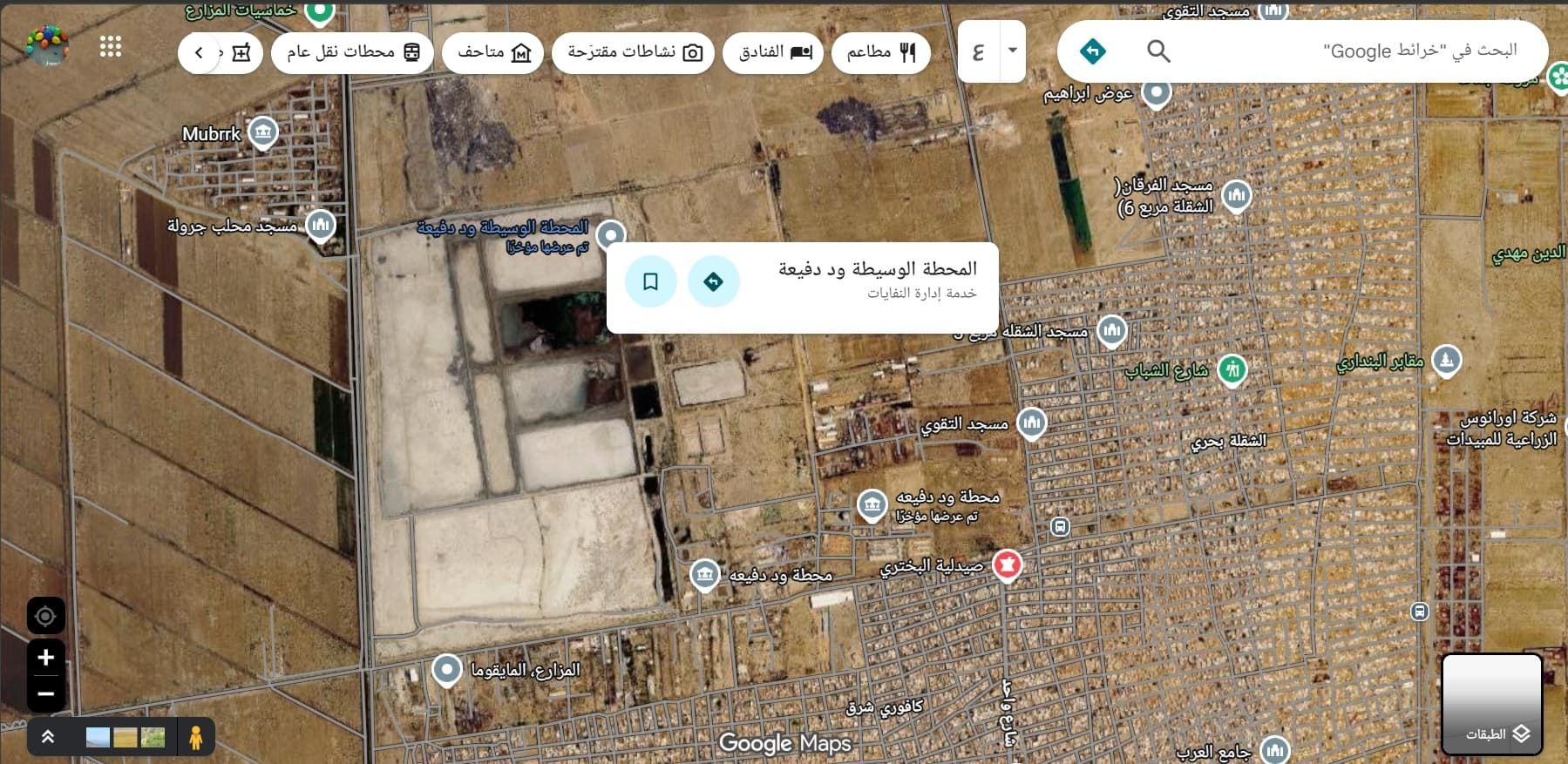
Satellite image showing the Wad Dafai’a Intermediate Waste Transfer Station, Sharg Al-Neel locality.
What about residential neighborhoods and side streets?
Residential neighborhoods and side streets are not receiving adequate waste collection services for two main reasons: a shortage of vehicles and a lack of waste containers. Al-Siddiq explained that, when vehicles are available, side streets may be serviced as infrequently as once a week.
He added that areas generating larger amounts of waste are prioritized whenever vehicles and fuel are available. He also noted that waste collection vehicles are no longer able to enter residential streets at all under the current circumstances.
If neighborhoods are not being covered, how do residents dispose of their waste when there are no containers available within these areas?
He explained that the department currently lacks the resources and capacity needed to provide this service. As a result, waste management within residential neighborhoods has become a shared responsibility between residents and neighborhood committees. The department provides supervision and machinery, while neighborhood committees are responsible for supplying the fuel needed to transport the waste. This is how waste disposal is currently managed in neighborhoods without waste containers.
What about war debris? How is it handled and disposed of?
On this issue, Al-Siddiq clarified that war debris does not fall under the responsibility of the Waste Management Department. Instead, it is handled by the War Remnants Removal Committee, the authorised body responsible for dealing with burnt-out vehicles and military objects.
He also warned residents against burning war debris indiscriminately, as doing so can cause serious health and physical harm. Some of the objects may contain explosive materials that could detonate during the burning process.
What is the current plan for clearing the accumulated Waste?
Given the available resources and limited capacity, the current approach is to remove waste regularly from markets and major roads. Al-Siddiq highlighted another challenge involving neighborhoods whose residents have not yet returned, including Al-Mughtaribeen, Al-Safiya and Al-Sababi. He explained that the absence of residents makes it difficult for the department to estimate the amount of accumulated waste that may emerge from homes as people return to these areas.
This uncertainty makes it harder to accurately assess the actual resources and capacity required for cleaning operations and waste disposal.
What are the environmental risks associated with waste accumulation in residential neighborhoods?
Al-Siddiq explained that the environmental consequences fall into two categories: The direct effects include the spread of flies and rodents, as well as the potential contamination of soil and water, particularly stagnant water during the rainy season.
The indirect effects are associated with residents burning waste indiscriminately. Such waste may contain a mixture of different and potentially hazardous materials. Burning these materials can release smoke and fumes that may cause health problems, particularly for children and people with respiratory conditions.
Have any initiatives or support been provided by non-governmental organizations?
Regarding support initiatives, Al-Siddiq identified an initiative by Sadagaat Organization and the United Nations Development Programme (UNDP) under its "Cash-for-Work" program, which carried out cleaning and waste removal at the Shambat Central Market, the largest market for fruits and vegetables in the city of Bahri. Furthermore, Sadagat Organization provided comprehensive support by supplying cleaning equipment and tools.
Another community initiative was organized by young people from Al-Shaabiya neighborhood, who cleaned several major streets in Bahri in cooperation with the Bahri Locality Waste Management Authority.
What is needed to restore the waste management system to normal operations?
Al-Siddiq believes that restoring waste management services to their pre-war levels depends on providing the necessary equipment and tools discussed earlier. This includes adding new vehicles to the existing fleet and addressing shortages of waste containers and personnel.
He noted that approximately 20 vehicles require maintenance before they can return to service. He added that current support should prioritize repairing damaged machinery and providing additional waste containers, allowing the department to extend its services to more areas and neighborhoods in greatest need. According to Al-Siddiq, returning more vehicles to service would significantly improve waste collection operations, enabling work to be completed more efficiently and with less time and effort than relying solely on manual labor.
In closing, the Bahri locality Waste Management Operations Manager called for greater public awareness of environmental and public health concerns, particularly the dangers of indiscriminate waste disposal. He also urged local businesses and individuals, alongside international governments and organizations, to work together to improve waste management services amid the challenges facing the department, the losses it has sustained, and its limited financial resources.
The impact of war on operational resources
Before the war, waste management in Bahri Locality relied on a system comprising collection points within residential neighborhoods, waste containers, workers and vehicles to transport rubbish to transfer stations and final disposal sites. The system’s ability to cover residential areas depended on the availability of these resources and the regular coordination of waste collection and transportation between them.
The following chart illustrates the losses sustained by the Bahri Locality Waste Management Authority as a result of the war and how these losses have directly affected its capacity to collect and transport waste from residential neighborhoods.
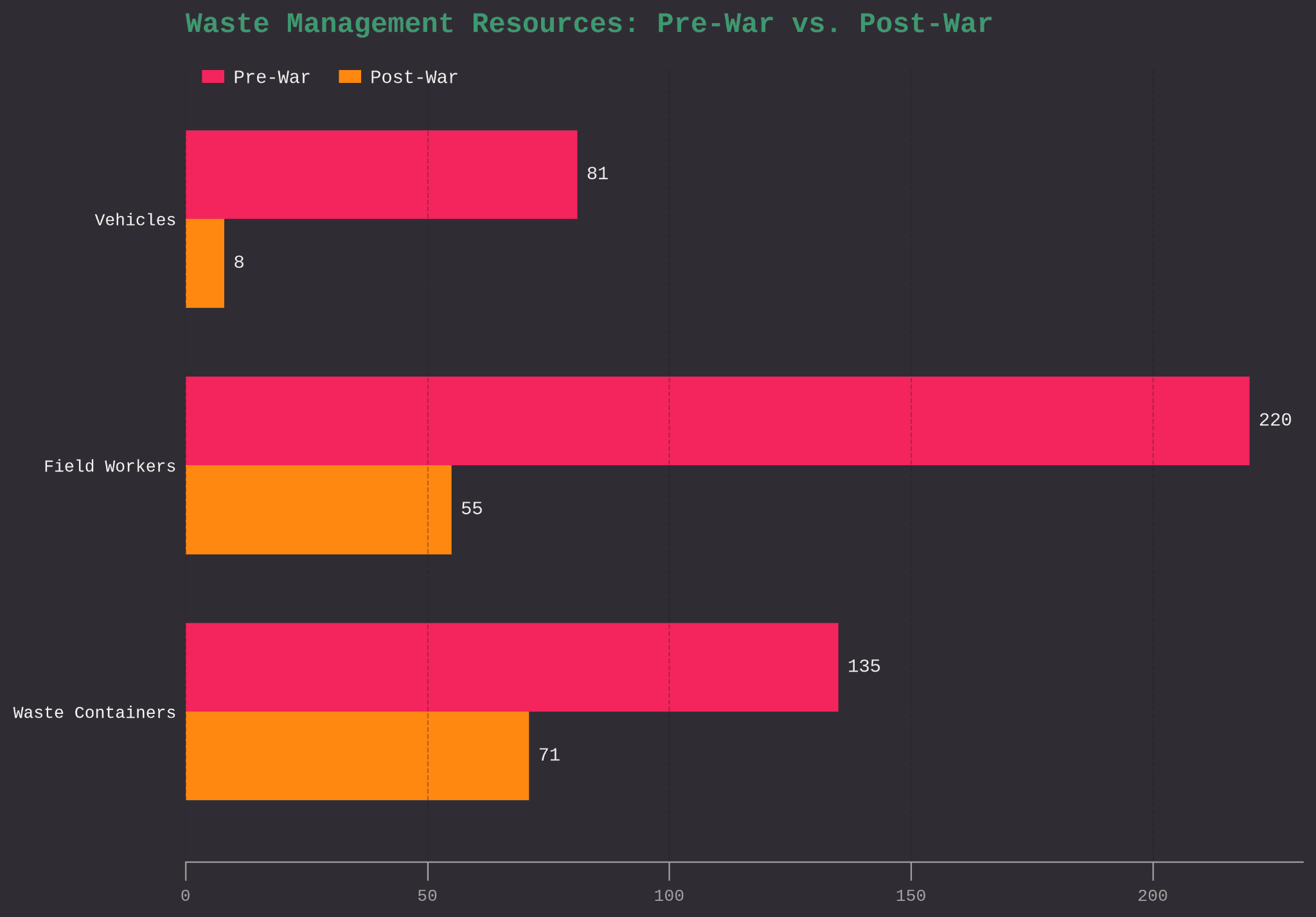
A comparison of the Waste Management Authority’s resources in Bahri Locality before and after the war
Vehicles and Machinery
Remaining operational vehicles: Only 8 of the 81 vehicles available before the war remain in service. Loss rate for vehicles and machinery: 90%
The substantial losses of vehicles and machinery have reduced the authority’s ability to transport waste and provide regular collection services in residential neighborhoods and side streets. This has contributed to the continued accumulation of rubbish within residential areas.
Human Resources
Current workforce: 55 workers, down from 220 before the war.
Reduction in workforce: 75%
The shortage of personnel is directly linked to the decline in the number of waste collection vehicles, as operating these vehicles requires workers to collect rubbish and load it for transportation. At present, the available workforce is concentrated mainly on major roads and markets, alongside the crews accompanying the vehicles that remain operational. This has created a significant gap in service coverage, particularly in residential neighborhoods and side streets that are difficult to reach regularly.
Waste Containers
Remaining containers: 71 containers, located in markets and key areas, out of 135 available before the war.
Loss rate for waste containers: 47.4%
Although losses of waste containers have been lower than those affecting other operational resources, the shortage has had a direct impact on residential neighborhoods. As the number of containers available in these areas has declined, many residents have resorted to dumping rubbish bags indiscriminately. This is happening amid a lack of waste containers and the absence of collection vehicles from residential streets, unlike before the war.
Waste collection within residential neighborhoods can therefore be understood as a system built around three interconnected elements: the collection vehicle, the worker and the waste container. For this system to function regularly, all three elements must be available. A shortage in any one of them directly undermines the efficiency of collection and transportation, ultimately widening the service gap and contributing to the accumulation of rubbish in residential areas.
Waste Volumes in Bahri
The extensive losses of vehicles and machinery have significantly affected the Waste Management Authority’s ability to transport waste daily to the intermediate transfer station in Wad Dafai'a.
The limited number of available vehicles has created a gap between the amount of waste generated each day and the amount that can be transported to the station. This gap did not exist before the war, when the authority had access to its full range of operational resources and could collect and transport larger volumes of waste.
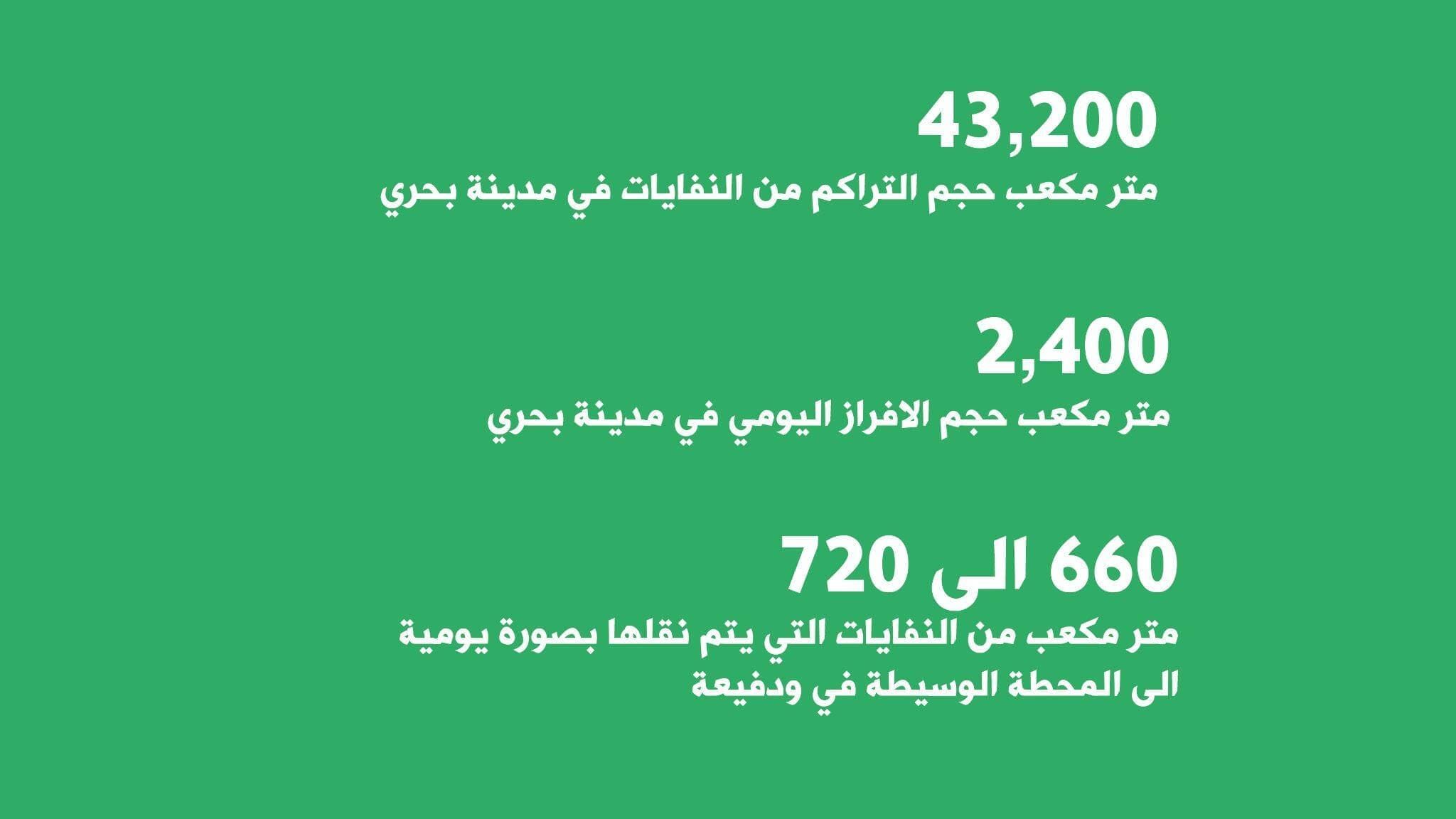
Figures on waste volumes in Bahri City. Source: Bahri Locality Waste Management Authority
According to figures from the Bahri Locality Waste Management Authority, the volume of waste generated daily is estimated at around 2,400 cubic meters, while only approximately 720 cubic meters are transported each day. Subtracting the amount transported from the total daily waste generated reveals the scale of the gap:
2,400 − 720 = 1,680 cubic meters
This means that, according to these figures, approximately 1,680 cubic meters of waste remain uncollected and untransported each day. The figures illustrate the scale of the challenge facing Bahri’s waste management system amid the shortage of vehicles and machinery needed to transport waste.
Abu Adam… The High Cost of Waste Disposal
In the southern part of Khartoum, specifically in the Abu Adam area, Mohamed Abu Dujana describes the difficulties residents face amid the waste crisis. Abu Dujana, who lives in Block 4, says the problem is not confined to his neighborhood but affects several neighborhoods across Abu Adam.
According to Abu Dujana, the worsening waste crisis is directly linked to the return of large numbers of residents to the area in recent months. As people returned and the population density increased, the volume of waste generated by residential neighborhoods grew. However, waste collection and disposal services failed to keep pace, resulting in rubbish accumulating in streets and public spaces.
He explained that when he returned in 2025, following the recapture of Khartoum, waste was not a problem on the scale seen today. The amount of rubbish generated was relatively small, and residents organized regular neighborhood clean-up campaigns. But as more people returned, the volume of waste continued to rise, making it increasingly difficult to manage.
Regarding where rubbish accumulates, Abu Dujana says waste can now be found in various locations across the area: in front of an open public space, near the mosque, and even outside houses that remain unoccupied.
A Complete Absence of Waste Containers and Collection Vehicles
However, according to Abu Dujana, residents are not solely responsible for the problem. The Waste Management Authority also bears part of the responsibility, particularly because waste containers are absent and collection vehicles do not reach the side streets within residential neighborhoods.
He explained that waste collection vehicles operate on main roads but do not enter many of the internal streets, placing an additional burden on residents. Transporting rubbish bags to the nearest main road can require residents to walk up to a kilometer, making proper waste disposal difficult, especially when there are no containers within their neighborhoods. As a result, Abu Dujana says, some residents are forced to dispose of their rubbish at the nearest available spot, contributing to the emergence of informal waste dumps within residential areas.
The Lack of Collective Action and Community Initiatives
Abu Dujana says the growing volume of accumulated waste, combined with the absence of regular community initiatives and collective action, eventually drives residents to burn rubbish whenever they have the opportunity as a means of disposal.
He noted that the neighborhood committee previously attempted to launch an initiative to collect and dispose of waste. It contacted the Waste Management Authority for assistance, but the authority asked the committee to provide the necessary fuel.
Abu Dujana explained: “There was an initiative by the neighbourhood committee to dispose of the waste. The Waste Management Authority committed to providing the vehicles and workers and asked the committee to supply the fuel needed to operate the vehicles. Unfortunately, the cost of fuel, together with incentives for the workers, came to nearly 500,000 Sudanese pounds.” With costs mounting and living conditions remaining difficult, the initiative was never completed. As a result, Abu Dujana says, the waste crisis has persisted amid limited intervention by the Waste Management Authority and a lack of local initiatives to alleviate the problem.
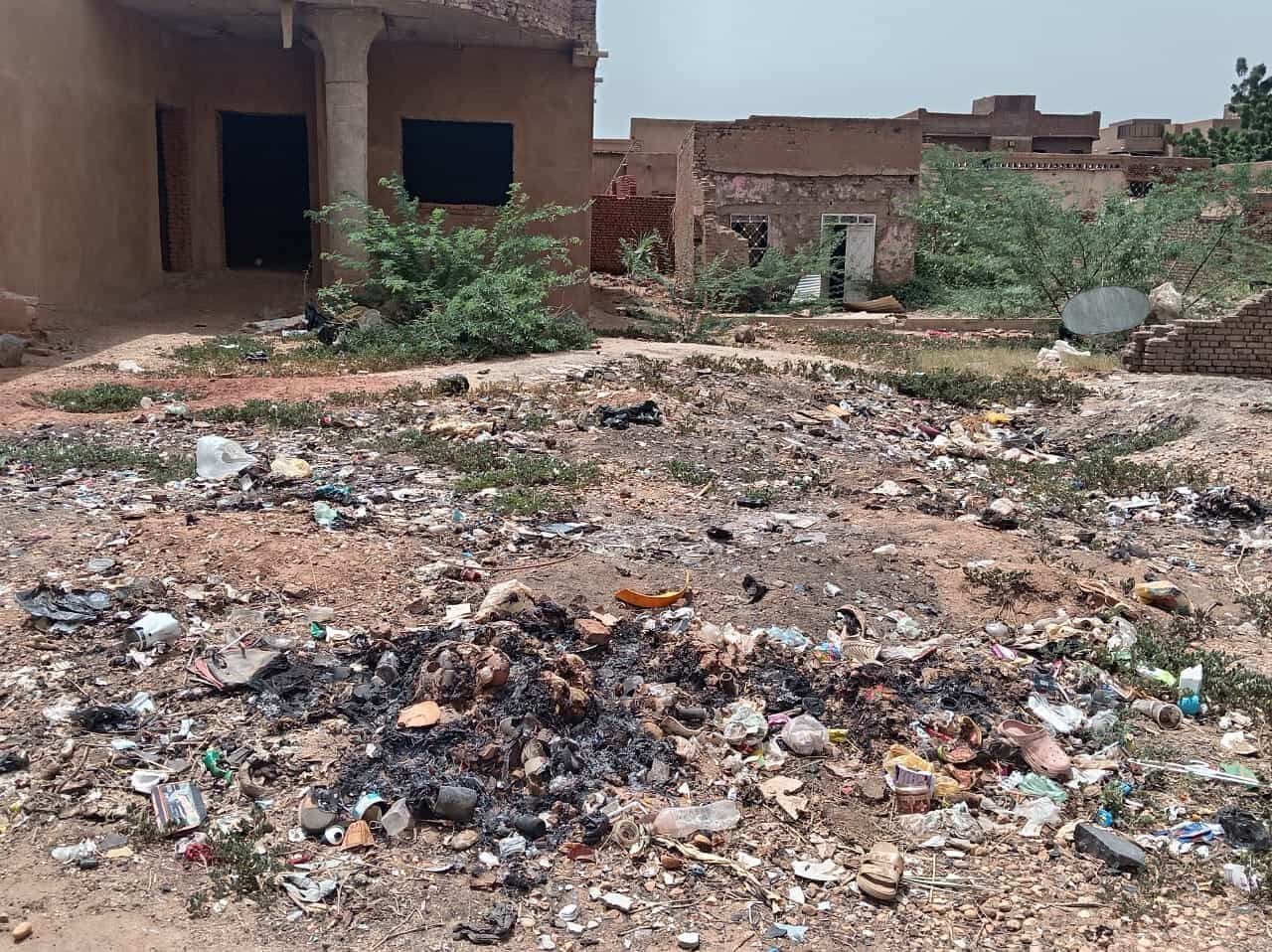
Evidence of waste, including signs of burning, near an abandoned house – Abu Adam area, Block 4. Credit: the author
Hardship continues in high-density residential neighborhoods
In Arkawit, Block 59, an eyewitness describes the waste crisis in the area, pointing to significant accumulations of rubbish across several neighborhoods and streets. He says the neighborhood where he lives has a high population density, particularly because it is home to several student dormitories. Waste accumulates at various locations within the neighborhood, including beside residential buildings and outside schools that are no longer operating. According to the witness, similar scenes may be found in other neighborhoods as well.
He adds that the neighborhood has no waste containers or rubbish bins, and waste collection vehicles have not returned since residents began moving back to the area. In response, the most notable attempt to address the problem was an initiative launched by local young people under the slogan “Hardship Makes Heroes.” The initiative aimed to remove waste from several neighborhoods by collecting it at a designated location and burning it. The witness also recalled an incident in which a live round of ammunition found among the rubbish exploded, although no injuries or damage were reported.
The most significant change compared with the pre-war period, he says, is the absence of the waste collection vehicles that once collected and transported rubbish. As a result, waste continues to accumulate across the area.
From Arkawit to the Jereif area, the situation is not much different. According to an eyewitness in Jereif West, Block 6, waste collection vehicles do not visit the neighborhood regularly, allowing rubbish to continue accumulating. The witness says the problem has persisted since July 2025 and remained unresolved at the time this report was prepared, with no noticeable improvement for more than a year. Rubbish continues to be dumped in the streets and outside homes.
In an attempt to address the crisis, resistance committees worked with the local authority to arrange a vehicle to collect the accumulated waste. However, the vehicle came only once. The committees also provided several rubbish bins, but these did not last long. They were damaged during the 2025 rainy season, and the problem soon returned. According to the witness, residents continue to suffer from the accumulation of waste and the associated spread of flies and insects.
“Some children in the neighborhood have developed allergy-related illnesses, and other unusual illnesses have appeared as well. We do not know whether they are linked to the waste, but because rubbish is constantly accumulating in the neighborhood, we suspect it could be the cause” he added.
The relationship between the accumulated waste and these reported symptoms requires medical assessment to establish their causes. It is worth noting that Jereif is one of the densely populated areas of Khartoum. This may mean that larger volumes of solid waste are generated there, requiring regular collection and transportation.
A Special Case: Al-Matar Neighborhood
Al-Matar neighborhood appears to be different from the areas discussed above. According to an eyewitness, a student at Sudan University of Science and Technology, the neighborhood is almost entirely free of rubbish. Waste containers are available, and collection vehicles visit regularly, reportedly up to three days a week.
She suggests that the relatively small amount of waste in the area may partly be explained by its low population. Much of the neighborhood remains sparsely populated compared with other parts of Khartoum, which naturally means that less waste is generated.
However, another factor may help explain why waste collection services operate more regularly in the area. As the Operations Manager of the Waste Management Authority noted at the beginning of this report, collection vehicles prioritize key locations and main roads. Given Al-Matar's proximity to Khartoum International Airport, the neighborhood's location and strategic importance may be among the factors explaining why waste collection services are more consistent there than in some other neighborhoods.
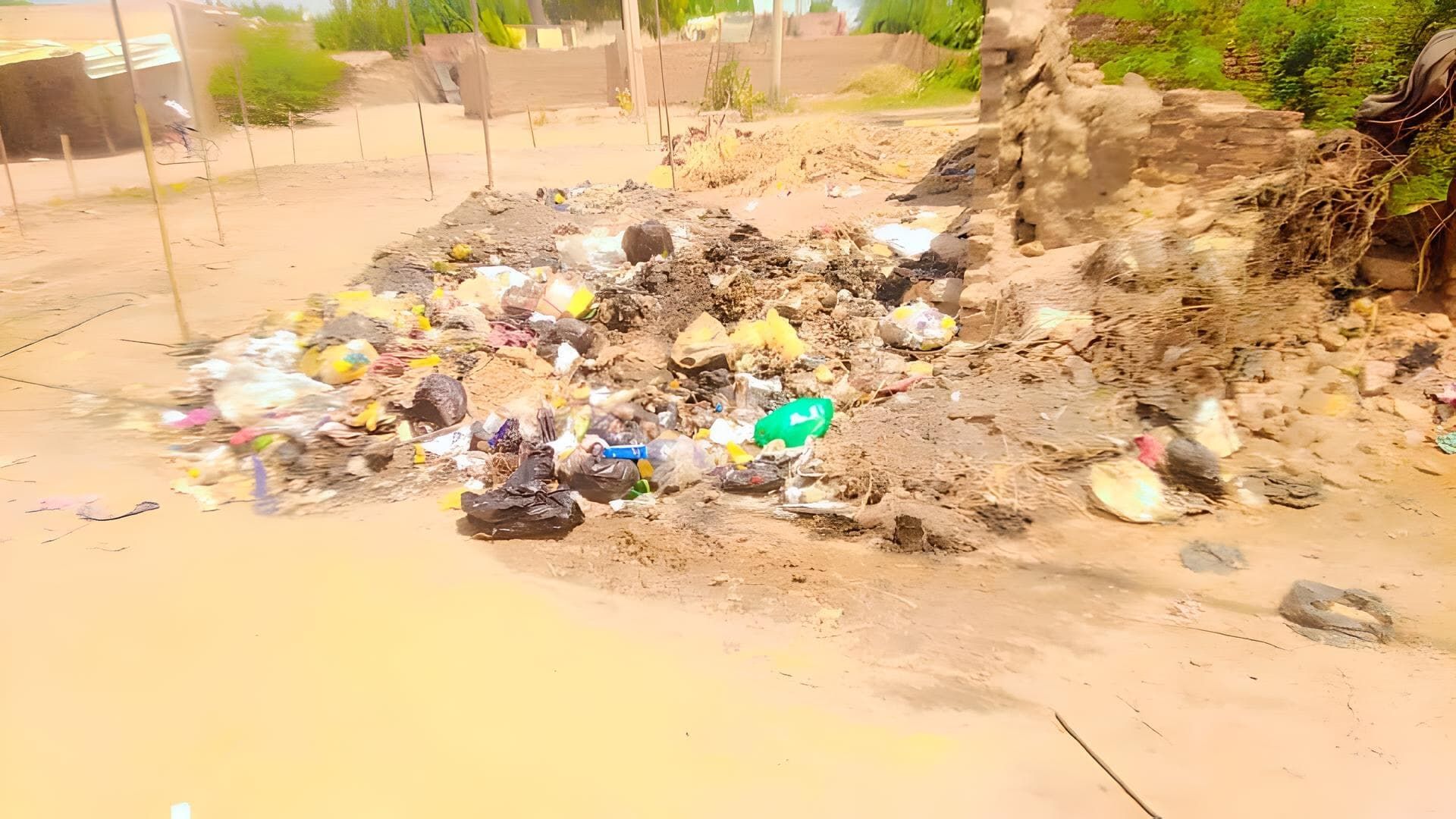
Waste piled up along a street in Jereif neighborhood. Credit: the author
War Debris: Accidents and Injuries
The effects of the war have extended beyond the accumulation of rubbish. Explosive remnants of war have introduced an additional danger. With waste collection services largely absent, residents resort to burning rubbish, which may contain unexploded ordnance and other hazardous objects. When exposed to fire, these items can detonate and cause injuries, turning waste burning into a danger that extends beyond its environmental consequences.
This situation highlights the need to raise public awareness about the dangers of handling unidentified objects. Residents should report suspicious items to the relevant authorities and avoid burning waste piles that may contain explosive remnants of war.
According to a United Nations Mine Action Service (UNMAS) factsheet, between January and June 2026:
- 108 people were killed or injured by explosive ordnance.
- 38 incidents involving explosive ordnance were recorded.
Half of these cases occurred in Khartoum and Gezira states, both of which have experienced large-scale returns of displaced residents. Children accounted for 55% of the victims whose ages were recorded. One such incident involved the explosion of a grenade in Al-Samarab neighborhood, north of Bahri. The explosion killed an eight-year-old child and seriously injured another.
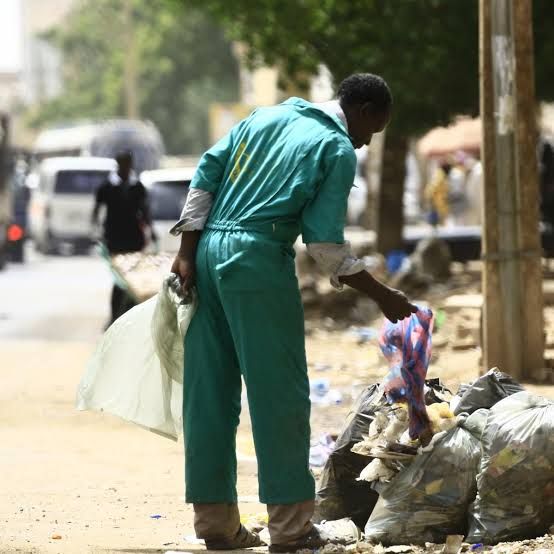
Sanitation workers have no one to pay their wages. Source: AFP.
Conclusion
Overall, the main features of the waste crisis in Khartoum and Bahri can be summarized as follows:
- The impact of war on waste management: The war resulted in the loss of some vehicles, machinery and other resources, reducing the operational capacity of waste management services. Limited funding has further undermined the system's ability to maintain services.
- Declining waste collection services: The absence of regular waste collection vehicles, particularly on side streets within residential neighborhoods, has contributed to rubbish accumulating for extended periods.
- Improper waste disposal: With waste containers and designated disposal sites unavailable, some residents resort to dumping rubbish near homes, schools and abandoned buildings.
- The link with population density: Waste generation is closely linked to population size. Densely populated areas produce larger volumes of waste, while the amount tends to be lower in areas where the population has fallen sharply because of the war.
The accumulation of waste in Khartoum's neighborhoods is not merely an issue affecting the appearance of streets and residential areas. It also contributes to the spread of insects, rodents and flies, particularly when rubbish is left uncollected for long periods. Children playing near waste piles face additional risks from dirt, sharp objects and contaminated materials. With collection services inadequate, some residents resort to burning rubbish, producing smoke and pollutants that can affect the respiratory system and aggravate allergic conditions.
If the situation remains unchanged as more residents return to other neighborhoods, the waste crisis could worsen in the coming months, particularly given the limited government and community-led interventions to address it. What may initially appear to be a straightforward problem of waste disposal becomes far more complex when its implications for the capital's urban environment, public health and environmental conditions are taken into account.