Breast cancer is now the most commonly diagnosed cancer among women worldwide, and its burden is rising rapidly across East Africa. According to the World Health Organization (WHO) and the International Agency for Research on Cancer (IARC), thousands of new breast cancer cases are diagnosed annually in countries such as Kenya, Uganda, Tanzania, Ethiopia, and Rwanda, with many women presenting at advanced stages when treatment is less effective. In several East African countries, more than half of breast cancer cases are diagnosed at Stage III or IV, contributing to significantly higher mortality rates than in high-income countries.
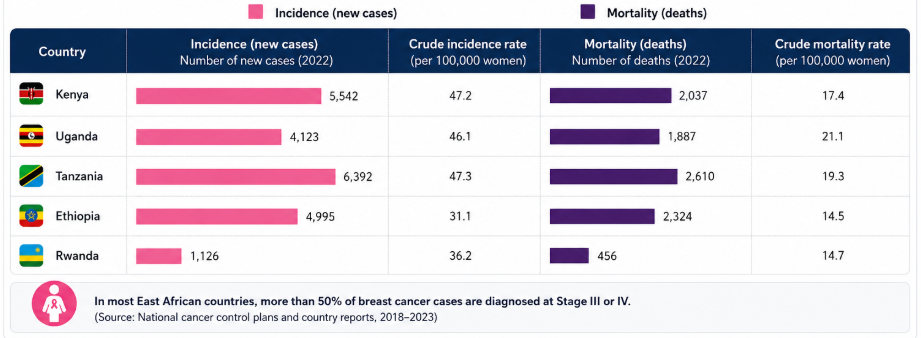
Estimated breast cancer incidence and mortality in selected East African countries (Source: IARC GLOBOCAN 2022)
Breast cancer is becoming an increasingly important public health challenge across East Africa. While mortality remains high because many women are diagnosed at advanced stages, a growing range of digital and technology-enabled initiatives are seeking to improve awareness, encourage earlier detection, and make breast-health information more accessible.
In Rwanda, the AI-powered IROZA assistant provides breast-cancer information and guidance through WhatsApp, including advice on breast lumps and pain, screening, reminders, and local health services, while the Rwandan platform Check Me combines breast self-examination guidance, health education, menstrual-cycle tracking, AI-supported assistance, and access to healthcare professionals.
Kenya has developed online and mobile support platforms for women living with metastatic breast cancer, providing psychosocial support, clinical information, links to healthcare facilities, and opportunities to connect with other patients, while the country’s newer IMARA–BC programme is expanding access to diagnosis, treatment and survivorship support.
In Ethiopia, a community-based breast-cancer initiative combined social media, radio, television, survivor storytelling and a mobile application translated into Amharic and Afan Oromo to help women recognize symptoms and learn breast self-examination, alongside pop-up screening events.
In Uganda, mobile screening and patient-navigation approaches are being explored to address geographic, financial and health-system barriers to early detection, while Tanzania and South Sudan continue to face significant gaps in breast-cancer awareness, screening infrastructure and access to specialized care.
In South Sudan, according to GLOBOCAN 2022 estimates, breast cancer caused an estimated 657 deaths in South Sudan in 2022, accounting for 12.9% of all cancer deaths in the country. Most cancers are diagnosed at advanced stages, the potential role of low-cost digital and community-based approaches is particularly significant. An emerging example of how AI could be adapted to address the social and gendered barriers surrounding breast-cancer screening is Life-Link, developed by Agot Alier Garang, Nyadieng Kuany War and Kajogo Nancy Wosuk. It is an AI-assisted screening and referral concept designed to allow women to assess potential breast-cancer risks privately before seeking clinical confirmation. The project responds not only to limited health infrastructure and late diagnosis, but also to cultural discomfort around physical examinations and the shortage of female doctors. Rather than presenting AI as a replacement for clinicians, Life-Link positions the technology as a preliminary screening tool that can help women arrive at healthcare facilities better informed and more prepared to seek professional assessment.
These examples demonstrate that digital innovation in breast cancer care can complement existing healthcare systems by making information more accessible, helping women recognize changes that require attention, reducing stigma and uncertainty, raising awareness about breast health, connecting patients with healthcare professionals, and helping them navigate the journey from noticing a potential change or symptom through to diagnosis and treatment. The strongest of these experiences also suggest that digital tools are most effective when integrated with community health workers, local languages, screening services, and human support.
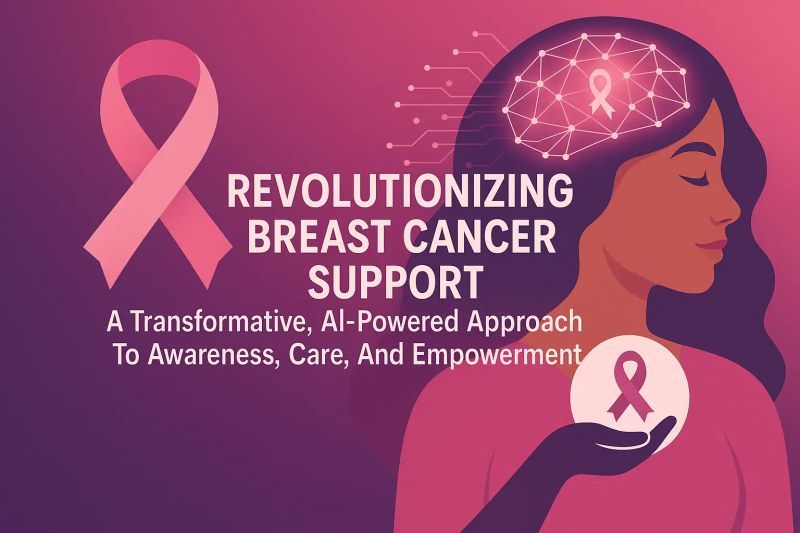
Technology and AI can revolutionize access and care for breast cancer patients. Source: Breast Cancer Initiative East Africa
The Difficult Journey to Access Care
For many women, access to cancer care begins with a difficult journey. Screening services are often concentrated in major cities, leaving women in rural and remote areas dependent on long-distance travel, transportation costs, and time away from work and family responsibilities. Even when women seek medical attention, delays in diagnosis can occur due to shortages of trained specialists, limited diagnostic equipment, and overstretched healthcare facilities.
These challenges highlight a critical gap between the growing need for cancer care and the capacity of health systems to respond. As breast cancer incidence rises across East Africa, improving outcomes will require expanding treatment infrastructure, strengthening awareness, early detection, health education, and community-based support systems that can help women recognize symptoms and seek care sooner.
The growing burden of breast cancer has also prompted policy responses across the region. Countries including Kenya, Uganda, Rwanda, Ethiopia, and Tanzania have strengthened national cancer control strategies, expanded early detection initiatives, and expanded cancer services in cancer centres and community awareness programmes. Regional collaboration through the East African Community (EAC) has further emphasized improving cancer prevention, diagnosis, referral systems, and access to treatment, although implementation remains uneven across countries.
Global Examples of Digital Innovation in Breast Cancer Care
The International Agency for Research on Cancer (IARC) has developed a digital Atlas of Breast Cancer Early Detection, featuring nearly 1,000 annotated images and videos covering examination, mammography, ultrasound and biopsy to support health workers, particularly where specialized training is limited. AI is also being tested in mammography, where a large Swedish trial involving more than 100,000 women found that AI-supported screening detected more cancers and reduced later-stage diagnoses compared with standard screening, while radiologists retained clinical responsibility. These findings highlight AI's potential to support early detection, although human oversight remains essential.
The DearYou mobile application is another example of how digital health tools can support breast cancer awareness through a broader women's health approach. The app combines breast self-examination guidance, self-check reminders, menstrual cycle tracking, emotional wellbeing monitoring, educational content, multilingual support (including English, Arabic, Amharic and Afaan Oromo) offline access in African countries such as Ethiopia, Liberia and Burkina Faso, and audio features for women with limited literacy. By integrating these features into a single platform, it makes health information more accessible and encourages women to become more engaged in preventive health practices.

Digital interventions can improve awareness, strengthen health literacy for women. Source: African Development Bank Group
Conclusion
Although the digital tools piloted in East Africa can improve awareness, strengthen health literacy, and help women recognize potential symptoms earlier, particularly in communities where access to health information is limited, digital applications cannot replace professional screening, diagnosis, or treatment. Their effectiveness also depends on access to smartphones, digital skills, and functioning healthcare systems capable of providing follow-up care when needed.
Rising breast cancer rates in East Africa highlight the need for stronger health systems, greater awareness, and improved access to early detection and treatment. Alongside recent regional efforts to strengthen cancer policies and expand early detection programmes, digital innovations can complement existing healthcare services by improving health literacy, encouraging timely help-seeking, and connecting women with appropriate referral pathways. While digital tools cannot replace medical care, they can help expand access to health information, promote preventive practices, and support women's health literacy. Combining healthcare investment with accessible digital innovation offers an important opportunity to improve women's health outcomes across the region.
