Perhaps, if we put on our historiographic glass onto today’s Ethiopian politics, the event that shaped it would name itself under the heading ‘Ethiopian Student Movement’ which later culminated to the 1974 total Revolution. What interests us in this article is the theoretical fertility of the Student movement in terms of articulating the hitherto ethnic and economic injustice ‘Ethiopain’s’ had faced under the imperial rule, historically, this amounts what I am tempted to call historico-political articulation; an articulation that put under question the master signifier Ethiopia. To tell of the history of the present is to tease out these formative decades. Thus, we begin by defining our terms and see how they are embodied within the student movement, the revolution, and how it reverberates in present Ethiopia.
What is an event? Is the question we must grapple with; an event is not mere occurrence, or provisional. The French philosopher Alain Badiou’s definition of event fits perfectly for theoretically tracing present Ethiopia. For Badiou, an event is a moment of radical change that introduced something unexpected into a situation. Badiou argues that events are rare and exceptional occurrences that challenge existing norms and structures, leading to a reconfiguration of social, political and historical reality. The historico-political articulation is primary manifestation of the event; an articulation of contemporary socio-political problems in historical terms.
An event also invest with new meaning to the master signifier; a signifier that represents an empty floating signifier that can come to symbolize a wide range of meanings and values. It serves as a nodal point around which other signifiers and meanings are organized, providing a sense of unity and coherence to a set of diverse and potentially conflicting ideas. An example of master signifier can be the nation, democracy, freedom, etc. Here, the master signifier is being an ‘Ethiopian;’ what is meant to be Ethiopian? Who is Ethiopian? The above theoretical arsenal typifies the Ethiopian student movement (1960-1974); whose aim was demystifying the imperial power, by showing that any relation that appear necessary is always pierced by contingency.
What was this necessary relation, the student wanted to expose? The beginning of modern Ethiopia is understood to be the year 1855 by the then emperor Tewdros, but here what interests us is not the succession of kings or the particularity of the processes; but rather how traditional historiography of Ethiopia and the counter-historiography of the 1960s tried to organize history, for the organization of historical narrative also means the organization of society.
The traditional historiography in Ethiopia is what is called the Great Ethiopian Tradition. It emphasis the making of the Ethiopian nation via the configuration of a text, which forms a network of monarchic justification; the textual origin of this tradition is the Kibra Negast; this book was the bedrock for legitimacy for the imperial Ethiopia.
This historical narrative, with a remarkable certainty, locate the origin of the Ethiopian nation to the ancient kingdom of Aksum; this narrative being cognizant of history’s truism that things change, but is also blaspheme history by ultimately affirming the continues thread of the nation’s existence. The truism of history brought down the Aksumite kingdom and succeeded by the Zagwe dynasty; but the Aksum kingdom was restored in 1270, under the mythology of the decedent of king Solomon of Israel, ushering in a century of legitimizing discourse, and it was not reason or man but antiquity wrapped around divine justification was the major of all things.
The counter-historiography 1960s, especially the student movement (SM), was a period of ‘historico-political articulation.’ It was an articulation of contemporary socio-political problems in historical terms; were history became a prison house (in the good sense of the term) i.e. where ‘atemporality’ was questioned, where the invocation of history lead to the immediacy of change, where the monarchic-hierarchy and its attendant identities is questioned, and lastly where history entailed demystification.
Cover page of kibre Negest. Source: Havileh Haus
Then, how did the 60s historico-political articulation and its primary ‘event’ SM engaged in demystifying the imperial regime? The demystification process was informed and made possible by different incidences that challenged the state; the 1960 coup was an important one. Despites its limitation, in terms of what it sought, and failure, it was the first discursive violence that showed the fallibility of the emperor. By discursive violence I mean, the change of meaning the person of the emperor and shows that any relation that appear necessary is always pierced by contingencies; the coup was the moment that showed the contingency of the monarchical power.
In the 1960s the student movement was the dominant force of protest between 1960s-1974 (Lemma, L. (1979). It was well informed by Marxism-Leninism, which helped them in locating the problem not at level individuals but at the social structure that sustained the exploitative social relations of production. Their commitment to Marxism-Leninism also identified at the heart of this social structure there laid unequal treatment of ‘ethnic and linguistic groups.’ Not only identified those cultural and structural problems but also give an answer to it which was total social revolution.
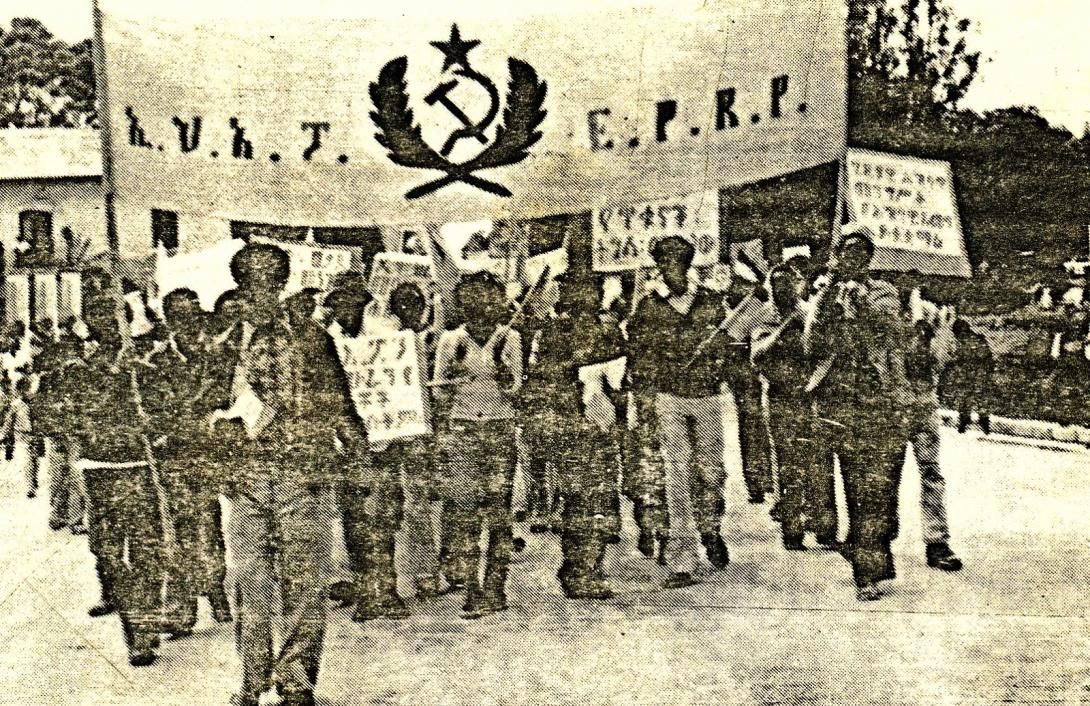
Students rallying to show their opposition against the monarchical regime. Source: Ethiopia Observer
The debate on class and ethnicity was seen via the prism of Marxism-Leninism; the one overemphasizing the Leninist dictum of self-determination of nationalities and other accused the former of de-contextualizing Lenin’s claim of self-determination. The former decried national oppression surpasses the socio-economic oppression; they were trying to foster what Benedict Anderson called community, defined as “regardless of the actual inequality and exploitation that may prevail in each, the nation is always conceived as a deep, horizontal comradeship.” On the other hand, in a Marxist fashion, they argued nationality question would be solved as a consequence of solving socio-economic inequality.
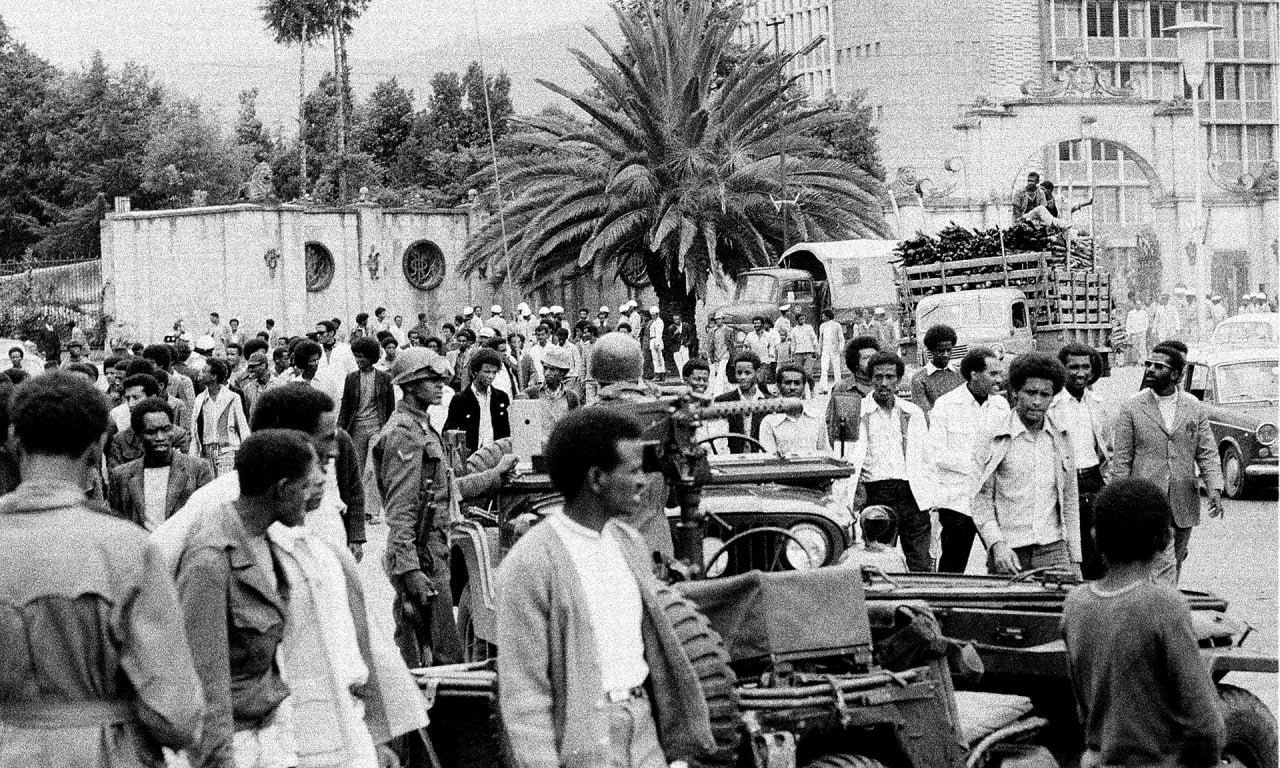
University students gathered around Arbegnoch square. Source: The guardian.
It was on this opening, of both conceptual and material, that the revolution took place. The students movement despite articulating the core problem of the imperial regime, failed to organize itself onto proper force that would usher and lead the revolution. But rather the more organized body of the regime, the military wing called Derg hijacked the revolution and spearheaded the revolutionary process. “The Derg, the military council that took power in Ethiopia following the overthrow of Emperor Haile Selassie in 1974 and ruled the country until 1991.”
As it’s a socialist regime it is expected to make typical socialist reforms, like nationalization of industries and business, and tried to cut the capitalist social relations of production. Importantly, the great synthesizer of the imperial Ethiopia, land; Derg’s land reforms ushered in large landholding were expropriated from feudal lords and redistributed to peasants and landless farmers.
In analysing this period one can find many writing emphasizing that the Derg neglected the nationality questions; and merely focused on interpolating citizens to some kinds of class. However, such assertion should be considered cautiously; as any regime, there were two faces to this regime, the official ideology and people’s sense of identity. The former claimed to adhere to the Marxist-Leninist formulation, (which was hijacked from the radical students of the 60s) this official ideology did try to end ethnic oppression, promoted the use of the other languages and cultures, and it even established the Institute of Nationalities in the mid-80s, to study the ethnic composition of Ethiopia; but this was futile sense the Derg was pursuing centralization and holding the country via military and bureaucratic power.
Young tells us that Derg “refused to share power with either the political conscious middle class or the emerging regional and ethnic elites and ensured it’s predominately ‘Amhara character’. This ensured to exclude certain force that claimed to stand and fight for their ethnic group to challenge the regime at any cost.
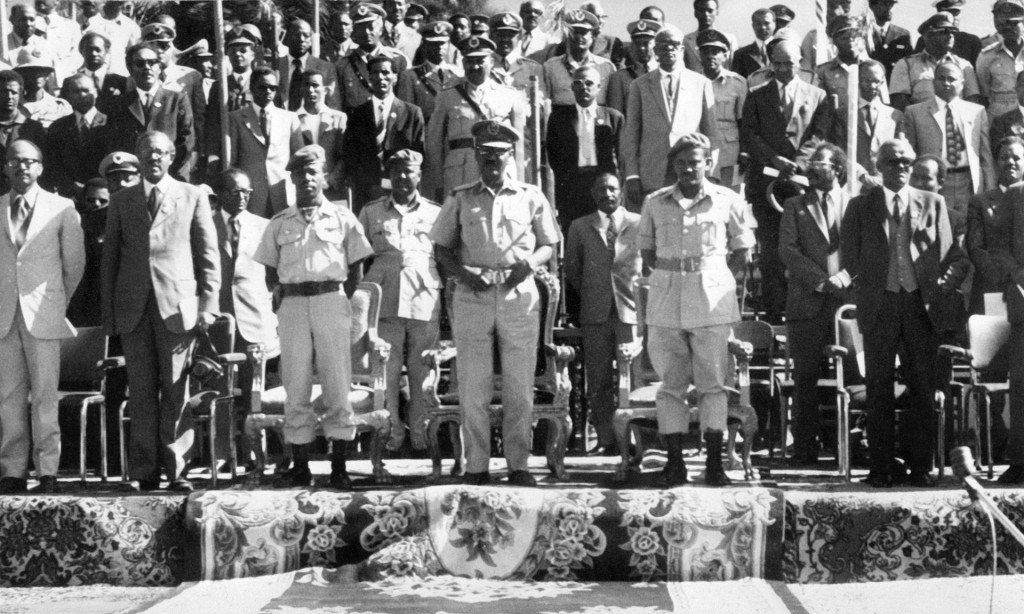
Addis Ababa, December 1974: Ethiopia’s Derg leaders, who deposed emperor Haile Selassie in September 1974. Source: J. M. Blin/AFP/Getty Images
All that historical and theoretical account we give helps us to situate the present Ethiopia; the period starting from the establishment of the constitution on 8 December 1994, announced the triumph of the category of the ethnic.
After the collapse of Derg, post-1991 in Ethiopia ethnicity became that organized and fixed the social and the political. Unlike Derg’s passive acceptance of what ‘Ethiopia’ meant, the ethno-nationalists, spearheaded by the collusion government EPRDF, re-articulated Ethiopia to mean, as stipulated in the constitution, vaguely states “we the Nations, Nationalities and people.” Clearly contesting the Ethiopia depicted by the nationalists, Ethiopia signified at best multi-ethnic polity with right of self-determination up to secession, and at worst dominance of particular ethnic group.
Ethno-nationalism has been successful in reframing Ethiopia; one can assert that, the discrepancy that existed between official ideology and people’s sense of identity, which was evident at the time of Derg, cannot be said in post-1991 Ethiopia. Because, the idea of instituting ethnic federalism is not just governance structure, it has become the very thing that determines the being of people; it is an active identification that people are so interpolated to, any critique of it is interpreted as a danger to their very being.
In conclusion, to tell history of the present Ethiopia is to locate it in event that was instigated by the student movement in the 1960s, and which necessarily lead to the 1974 revolution. This was an event which interjected onto Ethiopia political scene the question of class and Ethnicity, by problematizing the Ethiopia imagined by the tradition historiography as being provincial. It is to this event we owe todays Ethiopia’s political scene, where ethnicity has become so sediment.