I was on a voice note with two friends last week. I asked them, simply, whether they feared for their children’s lives whenever they weren’t around. The pause before anyone spoke was longer than I expected.
“Honestly? Yes, every single day,” said Elvis, whose daughter is ten and is sent to school each morning and picked up by a boda boda rider in Nairobi’s Embakasi. “I used to think that was just anxiety. Now I think it just makes sense.”
Janie, who does not have children, was quiet for a moment before answering. “I don’t have a child, but I think about it every day,” she said. “Part of me even thinks about not having children at all. The world doesn’t feel like it’s becoming safer for a child, or for a woman.”
What my friends describe is not paranoia. It is a rational response to a real and documented crisis.
This was after, in Kilifi County, seven-year-old Bernedict Keziah left her home in Mweza Ngombe village on a Sunday afternoon to play with other children a few metres away. Her body was found the next morning on a murram road. A post-mortem confirmed she had been strangled, sexually assaulted, and her neck was broken. Her mother, Faith Namwezi, told reporters at Kilifi Hospital that she felt hopeless after losing her daughter, the couple’s only child.

Residents of Mombasa and Kilifi staged a project demanding justice after the defilement and killing of Bernadete Keziah. Sources: VOCAL Africa
"It's AI": When the Crisis Meets the Narrative
Then, on May 25, 2026, International Missing Children's Day, National Police Service spokesperson Michael Muchiri appeared on Citizen TV and said something that stopped many Kenyans mid-scroll. There was no surge in missing children's cases, he said. The alarm was largely a product of social media amplification. More pointedly: "We have the intrusion of AI and fakes. Some of the clips we have seen in recent times are recycled."
The response was immediate and furious. Commentator Loraine Ongoma put it plainly: "It's sad to see parents communicating to the public about their missing children, and all the government says is "it's AI"."
The police spokesperson was not entirely wrong. Africa Check confirmed at least one widely shared image of a suspicious van was AI-generated. Disinformation around missing children is real and dangerous. But what made Muchiri's framing so painful was the suspicion that a government more comfortable managing the narrative than confronting the crisis was using a legitimate concern about AI to dismiss a genuine one about children.
By the Numbers: What the Data Shows
Between January 2025 and March 2026, Kenya's own Child Protection Information Management System recorded 10,581 child protection cases: 1,952 abductions, 1,636 missing children, and 173 trafficking incidents. Roughly 23 children enter the system every single day. Of these, approximately 2,328 remain unaccounted for.

A protest in Nairobi's CBD in May 2026 calling for government action on missing children and femicide. Source: Al Jazeera
The Village That No Longer Exists
Fifteen years ago, my friends and I would be playing outside until dusk in Likoni Estate, Mombasa, or running errands through a rural market, and it barely attracted anxiety. Neighbors knew each other. Older children watched younger ones. The village, however clichéd the phrase, functioned as something real: a web of adults who collectively held responsibility for children who were not their own.
That world has been significantly eroded. Rapid urbanization has replaced inter-generational neighborhoods with anonymous apartment blocks where families do not know who lives next door. Economic pressure has made absentee parenting a near-universal condition.
In Kilifi, children's officer Apopo Warren described what he sees daily: "Parents are absent. Some spend even more than a week away without knowing how their children are faring." Families pushed to the periphery of cities face concentrated vulnerability. Children travel longer distances to school. They return home after dark. They are more often unsupervised for longer stretches.
Into this space, predators move.
And then there is the internet, the most seismic shift of all. The DCI's Anti-Human Trafficking and Child Protection Unit has noted that many cases of physical abduction begin online: grooming, trust-building, and luring through social media platforms that children as young as ten now navigate without supervision. A world that once required physical proximity to harm a child has been replaced by one that requires only a smartphone and a SIM card.
When the Community is the Only First Responder
When a child goes missing in Kenya, the state is rarely the first call. In most communities, urban or rural, the immediate response is the network: relatives, neighbors, the church, the mosque, and the village elder. Flyers are printed. WhatsApp groups light up. Pastors make announcements from pulpits.
Missing Child Kenya, an NGO that coordinates tracing efforts, handled 158 cases in 2025 alone. Its founder and CEO, Maryana Munyendo, is clear-eyed about what remains when the community can't resolve things. As reported by the Daily Nation: "The 69 unresolved cases are not statistics. They are children, families, and communities living in prolonged uncertainty, and each report represents a moment when an ordinary day turned into a crisis." Of those 69 cases, 41 involved teenagers who had wandered into peer networks, urban mobility, and school transitions that no one was tracking.
In May 2026, a woman identified only as Cynthia described to TUKO watching CCTV footage from a shop near her home, showing a stranger in a hooded jacket leading her daughter away after buying her two small cakes. She knows what she saw. The suggestion that her terror is partly the product of AI-generated content landed, to her, as a kind of abandonment.
The Silence Around Abuse
For every child whose disappearance makes headlines, many more experience harm that is never reported at all, not to police, not to a hotline, not even to a trusted adult.
Cultural norms across many Kenyan communities still treat abuse, particularly by family members, as something to be managed internally. Shame migrates from perpetrator to survivor. Reporting is experienced not as protection but as exposure of the family, of the community, and of an intimacy that outsiders are not supposed to see.
A 2021 survey by the African Child Policy Forum found that over 40 percent of primary school teachers were unaware of their legal obligation to report suspected abuse. Teachers who do know often face social pressure not to act.
At Kilifi County Referral Hospital, in a case documented by UNFPA in East and Southern Africa, psychologist Raymond Gitana recounted the experience of a young boy who disclosed sexual assault only to be met, not with protection, but rejection. His father accused him of homosexuality and threatened to disown him. The community response, Gitana noted, deepened the harm far beyond the initial abuse.
Exploitation Wearing the Face of Care
In May 2026, DCI detectives arrested Almasi Rama Amos, a 27-year-old man who had been running what appeared to be care centers for vulnerable girls in Mombasa and Kilifi counties. The facilities offered mentorship and support. In practice, according to investigators, they were being used to sexually exploit and traffic minors. Detectives found him at a hideout in Kisauni with three underage girls. When he led officers to a second facility in Ribe, Rabai Sub-County, 19 more girls were found.
Twenty-two children were rescued in a single operation. The case illustrates something important about how exploitation now operates in Kenya. It wears the face of care. It uses the language of rescue. It targets girls from fractured families’ who have already been failed by primary networks of protection and offers them something that looks, for a moment, like safety.
As reported by the Daily Nation, the suspect allegedly recruited minors from dumpsites and poor families, transporting them across towns, withdrawing them from school, and in some cases impregnating them. Investigators described credible intelligence pointing to a wider trafficking syndicate operating within and beyond Mombasa County.
The DCI's Evalyne Mboya, who works in the Anti-Human Trafficking and Child Protection Unit, has described the range of motives behind child disappearances: grooming for sexual exploitation, illegal adoption, ransom, forced labor, organ harvesting, and ritual practices. These are not isolated aberrations. They are, in some instances, organized enterprises that depend on children being invisible, unregistered, undocumented, outside the reach of any institution that might notice them missing.

A picture of Almasi Rama. Sources: DCI Kenya X account
The Law Exists. So Does the Gap.
Kenya's legal architecture for child protection is genuinely impressive: the revised Children Act 2022, the Sexual Offenses Act, and the Cybercrimes Act. The problem is not the law. It is the distance between the law and the child who needs it.
The Department of Children's Services is chronically understaffed, with some counties operating at a ratio of one children's officer for more than 50,000 children. Fewer than 15 percent of reported child sexual abuse cases proceed to successful prosecution, according to UNICEF Kenya. Cases that do reach court can take two to four years, during which child witnesses are expected to remain emotionally available and willing to testify.
Civil society organizations, including Trace Kenya, the Kenya Society for the Care and Protection of Children, and Legal Sister Organization, fill gaps left by the state. They run safe houses. They provide legal aid. They sit with survivors. But they depend on donor funding, whose priorities shift over time, and are concentrated in urban centers. A child in rural Turkana, or on the outskirts of Eldoret, where children disappeared in a cluster that deepened public alarm, is often beyond their reach as well.
What is Working, and What is Still Missing
There are signs of progress. Kilifi's positive parenting programme, which trains village elders, Nyumba Kumi ambassadors, and counselors in child rights, has recorded sharp declines in neglect cases in participating areas. MPs visiting the Kilifi children's remand home in May 2026 noted that child protection funding is set to increase in the 2026/2027 budget. One MP acknowledged that it was only a drop in the ocean, but that it represented movement in the right direction.
What is missing is not knowledge of what works. It is sustained political will across budget cycles, institutional accountability that tracks what happens to cases after they are reported, and a cultural shift that treats the protection of children not as a women's and children's services issue, but as a fundamental measure of national health.
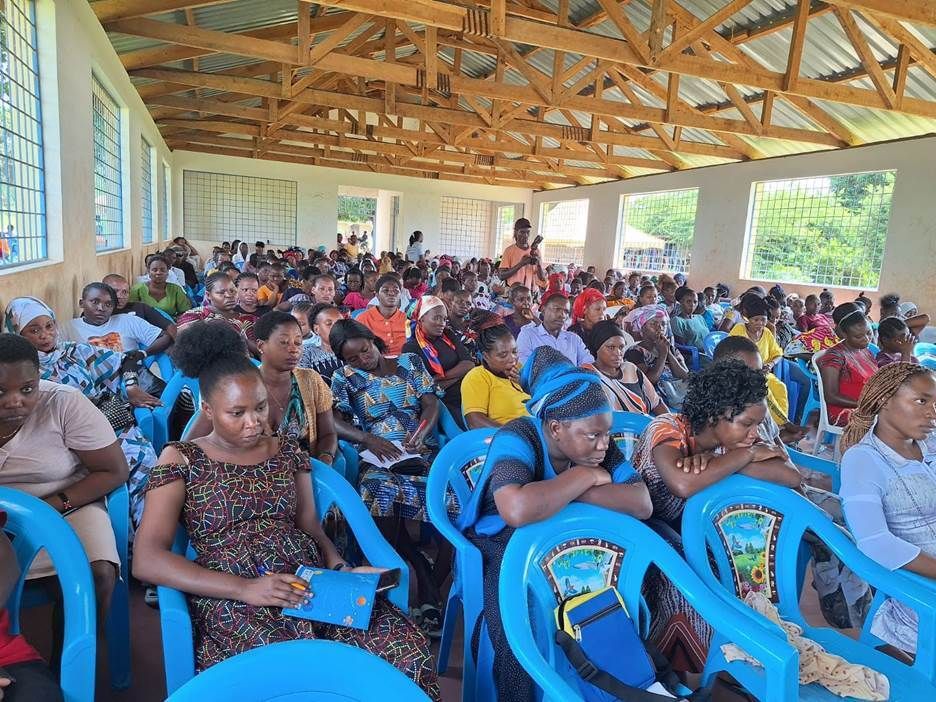
Community members at a child protection awareness, on the day of the African child event in Kilifi County, 2025. Source: Nation Africa
Faith Namwezi, Keziah's mother, sat at Kilifi Hospital and said she felt hopeless. The laws that should have protected her daughter exist. The institutions that should have caught the person who killed her exist. The gap between those institutions and the reality in Mweza Ngombe village is not, at its core, a technical problem. It is a gap that is felt across Kenya.
Conclusion
What ties these stories together is not only the violence itself, but also the silence and strain that follow it, in homes, in communities, and within the systems meant to protect children. Fear has become part of daily decision-making for many families, shaping how children move, learn, and are trusted in public spaces.
Yet fear alone is not the end of the story. Across Kenya, there are signs of response: survivors finding support, communities attempting prevention, and institutions slowly strengthening child protection frameworks. But these efforts remain uneven, often dependent on chance, geography, or individual commitment rather than on a consistently enforced national system.
The question, then, is not whether solutions exist. It is whether they will be sustained, funded, and treated with the urgency they demand. Until then, safety for children will remain something many families must constantly negotiate rather than something they can simply assume.