We have all attended a family gathering or get-together when we were not feeling well, attracting the attention of relatives who gave us advice on the best remedies. Some will recommend the best medical doctor to consult, while others will be ready to offer a homemade antidote that can make us feel better.
In reality, these traditional medicines rarely heal the ailment, but offer a momentary relief. Most of these medicines serve as a placebo, so it's hard to imagine that they could be popular and passed on from generation to another if they did not work. The tricky part about a placebo is that if you believe you will get better, then your symptoms will start to fade a bit. It will never completely cure the disease, but it will be of some relief and that is how most traditional medications work.
The World Health Organization defined traditional medicine as the skills and practices based on health practices, approaches, knowledge, and beliefs from various cultures, whether explicable or not. It incorporates plant, animal and mineral-derived medicines, spiritual therapies, manual techniques, and exercises, applied singularly or in combination in the maintenance of health and well-being to prevent, diagnose, improve or treat physical and mental illness.
The therapeutic outcome is very much related to expectancy, which is created mostly by belief and attitude and results in a placebo, or “meaning response,” effect both in modern and traditional medicine.
Centuries Old Magical Potion, Who are you to be Against it?
Skepticism is natural, but one might find themselves under the weight of tradition and peer influence to adhere to the kind of advice they are given, even if it has not undergone trials and received medical approval. When elders and occasionally peers pressure you into self-medicating with herbal concoctions, you might be persuaded to give it a try.
People worldwide, particularly in Africa, Latin America, and Asian counties have employed herbs as remedies to alleviate symptoms of many diseases since the ancient age and until today. This could be attributed mainly to the availability and relatively low cost of medicinal plants in these areas. Thus, it could be possible to develop novel drugs with possible anti-COVID-19 efficacy from herbs and their bioactive components.
During the first wave of COVID-19 and especially in Sudan, myths and misconceptions were spreading like wildfire, which led to many people resorting to drinking liters of mango juice, sour tea, hibiscus, and Acacia nilotica, commonly referred to as qarad, as medication. The same happened after the outbreak of monkeypox as speculators suggested that Nile Mud was a good cure for the disease.

Acacia nilotica (Qarad). Source: https://www.randomharvest.co.za/
Then where does the conspiracy begin? It begins when untested and approved traditional medications replace modern medicine completely.
Evidence emphasizes that herbal medicine could be worthwhile in the management of COVID-19. Still, there is a shortage of information on the anti-COVID-19 agents derived from medicinal herbal extracts and their bioactivities. Some governments in Uganda permitted the usage of herb-based medicines like COVIDEX in combination with Western medicine as an alternate therapy for COVID-19. At present, herbal remedies having antiviral biocomponents work as an auxiliary treatment to stop SARS-CoV-2 infections as the conventional treatment is not thriving.
Modern Medicine Versus Traditional Medicine
Traditional medicine vs. modern medicine has been a continuous debate for many decades. Since the invention of modern medicine, many people have not been ready to admit that they have been listening to and preaching traditional medicine and its holistic methods, using natural herbs and religious beliefs. In fact, they have been using the same herbs for all kinds of symptoms, diseases, and infections.
On the other hand, few people have always been in favor of modern medicine because it has always been supported by practical examples, tests, and scientific methods. They have been sending a strong message in the traditional medicine vs. alternative medicine debate, that traditional medicine or alternative medicine can be tested and upgraded to prevent upcoming diseases, if it is given in an appropriate quantity.
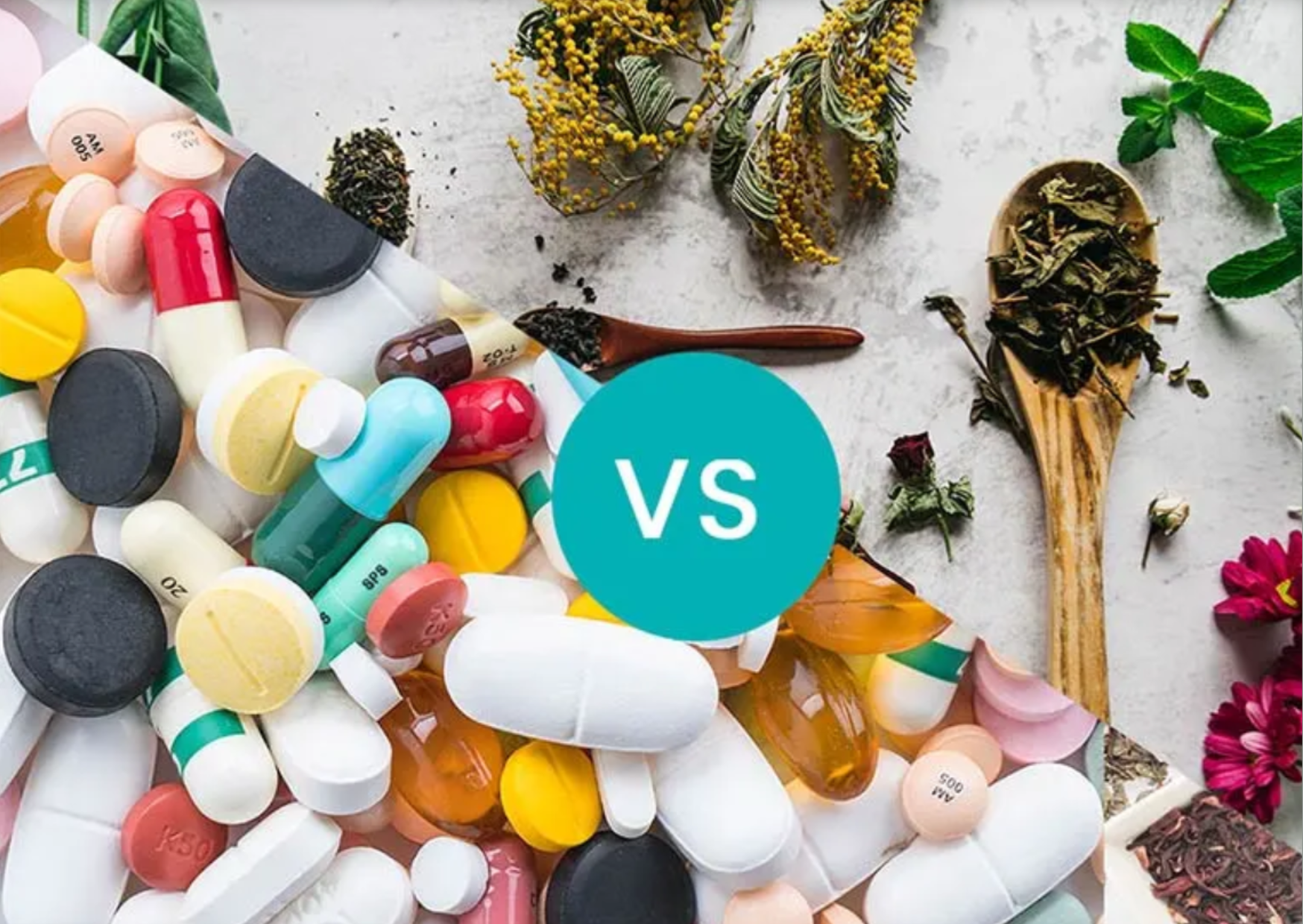
An image illustrating the debate between modern and traditional medicine. Source https://www.knowleswellness.com/
Another layer of the debate is that a lot of people think vaccines and shots are a part of an operation to limit the number of the planet's population, or in some cases eradicating a certain race or religious group- which is reminiscent of world war two eugenics. This conspiracy theory was very rampant during the COVID19 pandemic.
The Two Branches can Coexist for the Greater Good
An analogical model reveals that each aspect of modern medicine can be linked with an aspect of traditional medicine: herbalism to pharmaceuticals; midwifery to maternal and child health; bone-setting, blood-letting, and removal of foreign objects to surgery; and taboos to preventive medicine.
As Pretorius wisely said about traditional and modern medicine working in tandem, "the creation of a new type of national healthcare delivery system in Africa can be accomplished through the development of complementary services or of integrated services. Cooperation entails mutual referral, the institutionalization of training for traditional healers, and the use of corresponding drugs and supplies".

An image showing how traditional medicine can complement modern medicine Source: Women’s Health Network
The wellness culture that takes inspiration from mostly Eastern culture created a dichotomy between the two branches while in reality, they can be treated as a spectrum and can in fact complete each other. Modern medicine will be the cure for viruses and bacteria, it serves as an intervention, while traditional medication can serve as maintenance and not an upper fixer; it can inspire you to lead a healthy lifestyle without overindulgence that leads to neglecting the primary source of recovery.
Overall, when advocating for something that is shrouded in conspiracy, it is important to uncover its backstory and how it came to be to help the public accept it more. When it comes to traditional medication it is vital to think of it as a loyal companion or sidekick, rather than the main protagonist.